
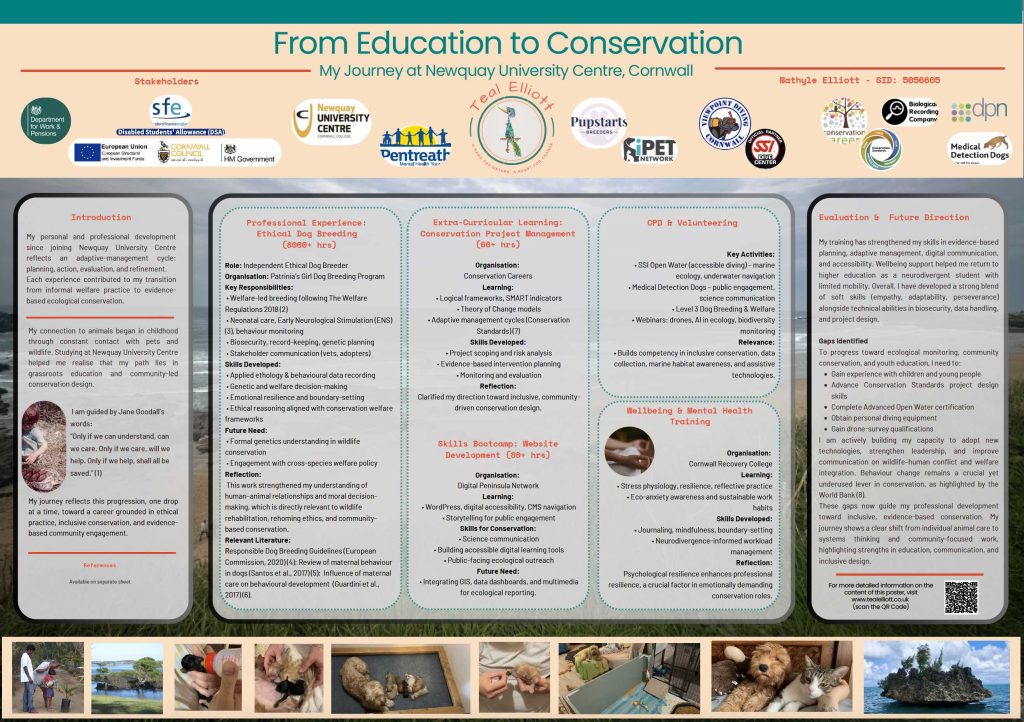
When I returned to education after years spent fulfilling family responsibilities, working, and navigating everyday life, while struggling to rebuild my life, I did not fully appreciate how much my past experiences had already prepared me for a future in conservation. That realisation surfaced unexpectedly while creating my poster for the Ecology in Practice module at Newquay University Centre in Cornwall.
The assignment required evidence-based reflection mapped against work experience, skill development, and professional growth. What I did not anticipate was that the process would function as a reflective lens, prompting me to recognise a period of my life I had not thoroughly examined and, in doing so, highlighting the close relationship between wellbeing and balanced work ethics.
Where the journey really began
My story did not start in a lecture theatre. It began in 2019, when long-term illness forced me to rethink how I could use my skills in ways that protected both my health and my future. I turned to something grounded, familiar, and ethically demanding: independent ethical dog breeding.
Over more than 8,000 hours of welfare-led animal care, I learned to work within The Animal Welfare (Licensing of Activities Involving Animals) Regulations 2018, ensuring the ethical breeding of dogs. I documented prenatal and neonatal behaviour systematically and communicated clearly and compassionately with veterinarians and adopters. Research into maternal behaviour and its influence on development (Santos et al., 2019; Guardini et al., 2017) transformed what initially felt instinctive into an evidence-based practice shaped by ethology, genetics, and ethics. With Newquay University Centre’s ticket contribution to do an extracurricular short course, I decided to do the Dog Breeding, Puppy Socialising and Welfare course with Puppy Start. I became increasingly aware of the impact of overbreeding domestic dogs and the carbon footprint of our pets, and I began considering lobbying for new rules and regulations, as well as laws, regarding the breeding and trading of dogs, along with other domesticated pets.
At the time, I did not recognise that all these experiences were with conservation foundations. I do now.
An early solopreneur and ecopreneur mindset
Looking back, what I was developing during this period was not just technical competence, but a solopreneur and ecopreneur mindset, long before I had the language to describe it as such. Operating independently meant I was responsible not only for animal welfare outcomes, but for ethical accountability, time management, financial sustainability, and long-term impact.
Ethical dog breeding requires systemic thinking: how individual decisions impact animal well-being, human trust, regulatory compliance, and future outcomes. This mirrors ecopreneurial practice, where environmental responsibility, ethics, and viability must coexist. I was effectively running a values-led micro-enterprise, grounded in welfare science, legislation, and reflective practice, which was duly registered where necessary.
This mindset later translated seamlessly into conservation thinking. Conservation, like ethical enterprise, relies on individuals who can work autonomously, adapt to constraints, communicate effectively across stakeholder groups, and make principled decisions despite imperfect information. The poster helped me recognise that I was not simply returning to education, but formalising and strengthening a way of thinking I had already been practising for years.
Turning points, divergence, and beginning again
Life intervened. I suspended my studies, regrouped, and focused on stabilising my health. In 2024, I returned to education on the FdSc Zoology, Ecology and Conservation pathway. It felt like starting over, except it was not.
My background in ethical breeding, early exposure to biodiversity education in Mauritius, and unconventional career history had quietly formed the backbone of my conservation identity long before I re-entered formal education. The poster helped crystallise this pattern: a transition from informal welfare practice to structured ecological thinking; from instinctive care to evidence-based decision-making; and from personal resilience to professional capacity-building.
When theory finally meets practice
A pivotal moment came during the summer of 2025, when I completed the Conservation Project Management and Design course with Conservation Careers. Learning to apply Theory of Change models, SMART indicators, and adaptive management cycles (Conservation Standards, 2025) reframed my understanding of conservation.
Combined with SSI Open Water training, where marine ecology became a lived experience rather than an abstraction, this learning bridged the gap between theory and practice. Conservation revealed itself not as a linear pathway, but as a system of interdependent parts that require communication, community engagement, and patience, alongside ecological knowledge.
The thought process behind the assignment
Creating the poster was not a simple academic exercise. It required cognitive organisation, emotional regulation, and academic rigour, alongside clear boundaries about what was appropriate to share publicly.
Cognitively, I approached the task as a project management exercise: scoping, filtering, selecting, and justifying content. Emotionally, I balanced honesty with professionalism, acknowledging the role of illness, disability, and neurodivergence without oversharing. Academically, each section was anchored to legislation, peer-reviewed research, or established conservation frameworks.
Why wellbeing belongs in conservation narratives
Including wellbeing in an academic poster may feel unconventional, but conservation is an emotionally demanding field. Burnout, eco-anxiety, and chronic stress are well-documented. Training with Cornwall Recovery College, which covers resilience, stress physiology, and neurodivergent workload strategies, has been as essential to my professional development as any field-specific skill.
Wellbeing is not a soft skill; it is a professional infrastructure.
Lessons learned
This journey reinforced three key insights:
1. Unconventional pathways into conservation are valid and valuable.
2. Reflection is a professional and scientific tool, not self-indulgence.
3. Boundaries matter; not everything needs to go online to be meaningful.
Call to action or Food for thought
For students, early-career conservationists, and organisations:
Create space for structured reflection.
Treat wellbeing as a core professional capacity.
Recognise solopreneurial and ecopreneurial thinking as assets within conservation practice.